December 4, 2025
TikTok Shop Auto-Approval: Cut Sample Review Time by 80%
December 4, 2025
TikTok Shop Auto-Approval: Cut Sample Review Time by 80%
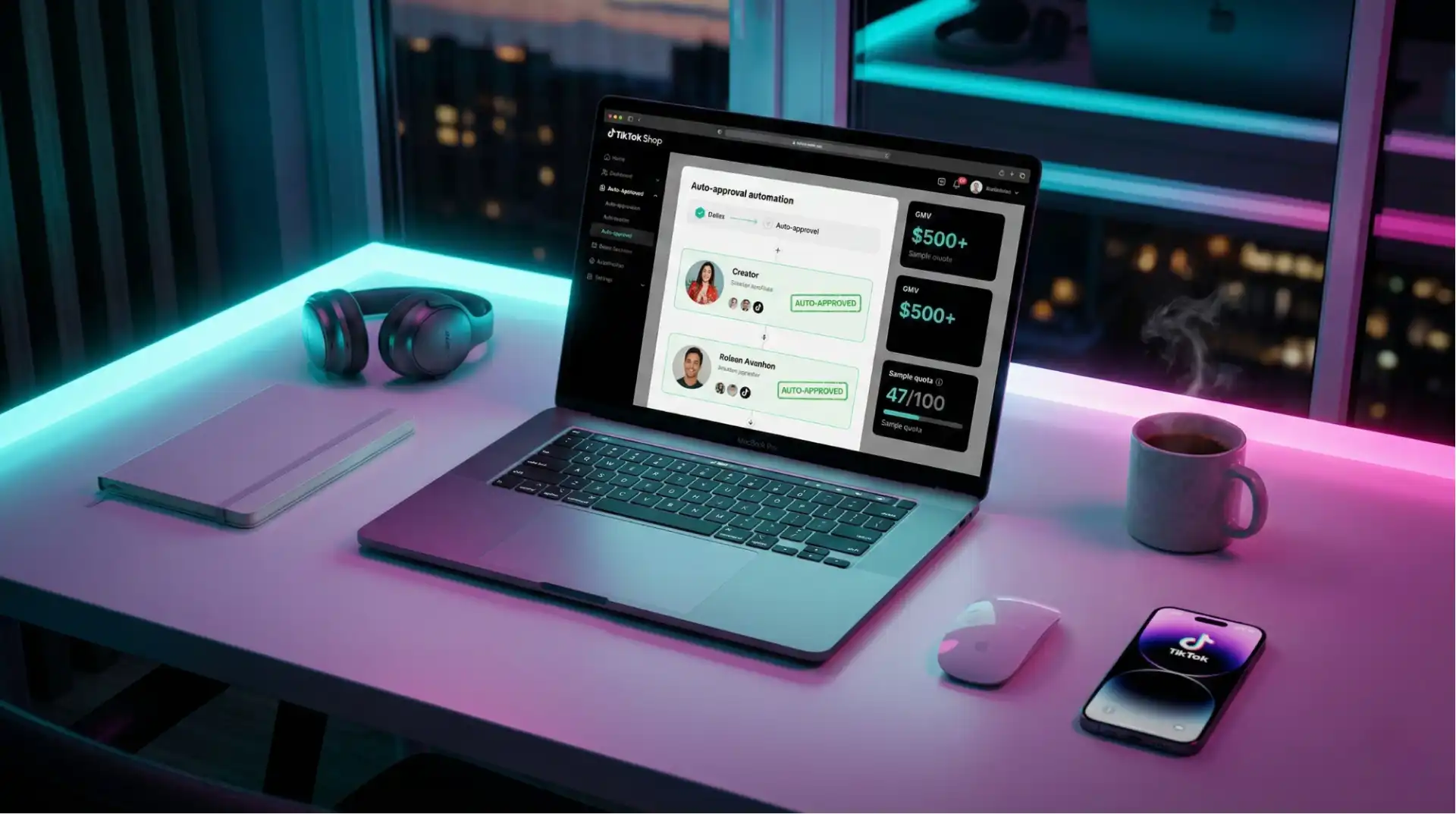
New TikTok automation approves creator samples instantly. Learn how to set quotas, GMV thresholds, and price limits to scale profitably.
How Auto-Approval Rules Turn TikTok Sample Chaos Into a Profit Machine
Executive Summary
What happened? TikTok Shop launched auto-approval automations for creator sample requests, allowing sellers to set custom creator criteria (30-day GMV, posting rate) and shop-level quotas that instantly approve qualifying creators without manual review.
Why should a Brand Owner care? If you're sending 50+ samples per month, you're burning 10-15 hours on approval queues. This feature cuts that to zero for high-performers, letting you focus manual attention only on edge cases. More importantly, it prevents low-GMV creators from draining your sample budget while auto-fast-tracking proven converters. As TikTok Shop matures in 2026, the brands that systematize creator vetting now will capture disproportionate market share while competitors drown in manual workflows.
What action is required today? Navigate to Sample Requests > Automations and configure your first ruleset. Set a conservative 30-day GMV threshold ($500+ recommended), cap your shop quota at 50 samples to start, and add price limits on products over $30 to protect margin.
The Deep Dive: How Auto-Approval Actually Works
What This Feature Solves (And Why It's Critical for 2026)
The core problem for scaling brands on TikTok Shop isn't finding creators—it's filtering them. When you open sample applications, you get flooded with requests from:
Zero-sale accounts hoping to flip free products
Nano-creators with 200 followers and no posting history
Serial sample collectors who never post
The manual review process becomes a full-time job. Auto-approval solves this by acting as a gatekeeper that runs 24/7, instantly approving creators who meet your performance benchmarks and sending everyone else to manual review.
Why 2026 Changes Everything: TikTok Shop is projected to hit $50B+ in US GMV by end of 2026. That means 3-5x more creators flooding the platform, all competing for samples. Brands without automated filtering will either hire full-time sample coordinators (killing margins) or miss high-potential creators buried in application noise. Auto-approval is the moat that separates brands who scale efficiently from those who scale expensively.
The 4-Step Setup (Strategic Walkthrough)
Step 1: Enable Auto-Approval in Automations
Go to your Sample Request page → Automations tab and toggle on "Auto-Approval Settings." This applies to both Open Collaboration (public sample listings) and Target Collaboration (manual review invites).
Agency Insight: Don't enable this blindly. First, export your last 90 days of sample approvals and calculate your actual conversion rate (samples sent → posted content → sales driven). If you're below 15% conversion, your criteria need to be stricter than TikTok's defaults.
Step 2: Define Creator Criteria (The Real Strategy)
You'll set thresholds for:
30-Day GMV: Minimum sales the creator has driven in the last month
Estimated Posting Rate: Likelihood they'll actually post content after receiving samples
How to Set GMV Thresholds:
Conservative (High-Margin Products): $1,000+ 30D GMV. These are proven sellers.
Aggressive (Low-AOV Products): $300+ 30D GMV. Casts a wider net but requires higher quotas.
Premium Brands: $2,500+ 30D GMV. Only top 5% of creators qualify.
The Posting Rate Trap: TikTok's "estimated posting rate" is algorithmic and opaque. In our testing, creators with 60%+ posting rates still ghost 30% of the time. Don't rely on this alone—always layer GMV requirements.
2026 Calibration: As the platform matures, average creator GMV is rising. What qualifies as "high-performing" today ($500 30D GMV) will be table stakes by Q3 2026. Plan to raise your thresholds 20-30% every quarter to maintain quality as the creator economy professionalizes.
Step 3: Set Shop Quota and Price Limits (Budget Protection)
Shop Quota (Mandatory): You must set a cap between 1-100 samples that can be auto-approved. Once this quota is hit, all new requests go to manual review.
Strategic Quota Sizing:
If you're spending $5K/month on samples and your average sample cost is $25, you can afford ~200 samples total
Set auto-approval quota at 50-60 (25-30% of budget) to reserve capacity for manual VIP approvals
TikTok processes requests in order received, so quota burns fast during traffic spikes
Price Limits (Optional but Critical): Set a maximum product price that can be auto-approved. If you sell $15 lip glosses AND $120 skincare sets, you don't want the system burning through $120 units on untested creators.
Agency Secret: Set your price limit at 1.5x your median AOV. If your average sale is $40, cap auto-approvals at $60. This protects premium inventory while still automating 70-80% of requests.
Step 4: Monitor the "Auto Approval" Tag
Once live, approved samples get tagged "Auto Approval" and move directly to "Ready to Ship" status. You can track this in the Approval Source column on your Sample Request page.
What to Watch:
Quota burn rate: If you hit your 50-sample cap in 3 days, either raise the quota or tighten GMV criteria
Post-approval conversion: After 30 days, compare auto-approved creators vs. manually approved. If auto has <10% posting rate, your thresholds are too loose
What Gets Excluded (The Fine Print)
Auto-approval does NOT apply to:
Auto-optimized samples (TikTok's existing automated system)
Refundable samples (deposits required)
Target Collaboration's fully automated approvals (separate automation already exists)
Why This Matters: If you're using Target Collab's native automation, this new feature won't override it. The two systems run in parallel. Auto-approval only touches Open Collaboration and Target manual review cases.
Product Hiding Rules Still Apply First: If you've already set hiding thresholds (e.g., "block creators with <500 followers"), those filters run before auto-approval. Hidden products never even appear in the creator's application list.
How to Leverage This for 2026 Dominance (The Zorilla Edge)
Strategy 1: Tiered Creator Funnels (The Scalable Framework)
Don't use one auto-approval rule for all products. Create a tiered system:
Tier 1 (Loss Leader Products): Set auto-approval at $200+ GMV, no price limit. These are $10-15 items you can afford to send broadly. Goal: maximize content volume.
Tier 2 (Core SKUs): Set auto-approval at $800+ GMV, $40 price limit. These drive 60% of revenue. You want proven creators only.
Tier 3 (Premium/New Launches): Manual review only. Auto-approval OFF. These require strategic partnerships, not volume plays.
The Profit Math: If Tier 1 generates 100 posts/month at $15/sample ($1,500 cost) and converts at 2% to sales, you need $75K in attributed revenue to hit 50x ROAS. That's only $750/post in sales—highly achievable with proven creators.
2026 Advantage: By mid-2026, brands with tiered systems will have 12+ months of performance data showing exactly which GMV thresholds produce optimal ROI per tier. Competitors starting from zero will spend 6-12 months learning what you already know, giving you a permanent data moat.
Strategy 2: Use Auto-Approval as a Creator Magnet
Creators see a "100% Approval" tag when they meet your criteria. This is a psychological trigger. They know they'll get the sample instantly, which increases application velocity.
Agency Hack: Advertise your auto-approval thresholds in your TikTok Shop bio and product descriptions:
"Creators with $500+ 30D GMV auto-approved instantly. Apply now."
This pre-qualifies traffic and attracts higher-performing affiliates who know they won't waste time on rejections.
2026 Context: As TikTok Shop becomes more saturated, top creators will become increasingly selective about which brands they partner with. The "100% approval" badge becomes a signal of professionalism and creator-friendliness. Brands that communicate clear, fair auto-approval criteria will win the war for A-tier creator attention while competitors beg for responses.
Strategy 3: Sync With Spark Ads Investment
The creators who get auto-approved are your best Spark Ad candidates. They're already driving GMV organically.
The Workflow:
Auto-approve creator → sample ships
Creator posts content → track organic performance
If video hits 10K+ views + 5% CTR in first 48 hours → request Spark Ad rights
Boost with $500-1K ad budget
Why This Works: You're only spending ad dollars on creators who've already proven organic traction. Auto-approval gives you a pipeline of pre-vetted content machines.
2026 Prediction: Spark Ads will account for 40-50% of profitable TikTok Shop GMV by late 2026 as organic reach continues to decline. Brands that build systematic pipelines from auto-approval → content → Spark amplification will own disproportionate share of voice while competitors waste budget on cold creator outreach.
Strategy 4: Dynamic Quota Management (Competitive Intelligence)
Don't set your quota once and forget it. Adjust monthly based on:
Inventory levels: If you're overstocked on a SKU, raise the quota and lower GMV thresholds to push samples
Seasonal peaks: Q4? Triple your quota. January slump? Cut it in half
New product launches: Disable auto-approval for 30 days post-launch to manually vet every creator for strategic messaging
The Dashboard Review: Every Monday, check:
How many samples auto-approved last week?
What was the posting rate of auto-approved creators?
Did any auto-approved creators drive >$1K in sales? (Add them to VIP Target list)
2026 Intelligence Play: By Q2 2026, TikTok will likely introduce more granular creator analytics (predicted engagement rates, category specialization scores, conversion velocity). Early adopters of auto-approval will have the cleanest historical data to feed these new algorithms, creating a compounding advantage. Your auto-approval system becomes a machine learning training ground that gets smarter monthly.
Strategy 5: Build the Creator Loyalty Flywheel
Auto-approval isn't just about efficiency—it's about relationship velocity. When a creator applies and gets instant approval, you've created a positive first impression. When they post and drive sales, you invite them to Target Collab with higher-value products. When they consistently perform, you offer exclusive early access to launches.
The 2026 Moat: By end of 2026, the top 500 TikTok Shop creators will drive 30-40% of platform GMV. Brands that used auto-approval to identify these creators early (when they were at $300-500 30D GMV) and nurtured them to $5K+ GMV will have unbreakable partnerships. Competitors trying to poach these creators in 2026 will face loyalty walls you built in 2024-2025.
FAQ (Frequently Asked Questiones)
Q: What's the ideal 30-day GMV threshold to set for auto-approval in 2026?
A: Start with $500 for most brands in early 2025, but plan to increase to $750-1,000 by mid-2026 as average creator performance rises. If you sell products under $20, you can start at $300 but should reach $500+ by Q3 2026. Premium brands ($50+ AOV) should target $1,500+ by 2026 to ensure only top-tier creators qualify.
Q: Can I use different auto-approval rules for different products?
A: No, TikTok's current auto-approval setup is shop-level, not product-level. However, you can use price limits to exclude expensive products and rely on product hiding rules to block low-quality creators from specific SKUs before auto-approval even runs. Expect TikTok to add product-level rules by late 2025 or early 2026—brands with clean auto-approval data will be first to leverage this.
Q: What happens if my shop quota runs out mid-month?
A: All new sample requests automatically route to manual review until you raise the quota. You'll get a notification when you hit 5 samples remaining. Best practice: set a quota that covers 30-40% of your monthly sample budget, not 100%. This reserves capacity for strategic manual approvals and prevents quota depletion during unexpected traffic spikes.
Q: Does auto-approval work with Target Collaboration invites?
A: Yes, partially. If you invite creators via Target Collab and they're set to "manual review," the auto-approval rules will apply. But if Target Collab already has its own automated approval active, that takes precedence and this feature won't interfere. By 2026, expect these systems to merge into a unified creator approval engine.
Final Takeaway: The 2026 Winner Takes Most Scenario
TikTok Shop is entering a consolidation phase. By 2026, the platform will be dominated by brands that built systematic, scalable creator operations in 2024-2025. Auto-approval isn't just a time-saver—it's the foundation of a creator acquisition machine that runs 24/7 without human bottlenecks.
The brands that will own 2026 aren't the ones with the biggest sample budgets—they're the ones who systematize creator vetting so they can focus human attention on strategic partnerships while algorithms handle volume.
Here's what separates winners from losers in 2026:
Losing Brands:
Still manually reviewing 100% of sample requests
Hiring coordinators to manage creator backlogs
Missing high-GMV creators buried in application noise
Sample budgets growing faster than revenue
Winning Brands:
Auto-approve 70-80% of samples based on performance data
Human review reserved for $100+ products and strategic launches
12+ months of creator performance data feeding smarter threshold decisions
Sample ROI improving quarterly as algorithms get smarter
Action Item for This Week: Enable auto-approval with a $500 GMV threshold, 50-sample quota, and $40 price limit. After 14 days, pull the Approval Source report and compare posting rates between auto-approved and manually approved creators. If auto-approved creators post at >20%, you've found free leverage. If they're below 10%, tighten your GMV threshold by $200 and retest.
The difference between a $500K/month brand and a $3M/month brand in 2026 won't be product quality or ad creative—it will be operational leverage. Auto-approval is the first domino. Set it up now, optimize it monthly, and by 2026 you'll have a creator machine your competitors can't replicate without 18 months of catch-up.
About Zorilla Marketing: We help 7-8 figure D2C brands scale profitably on TikTok Shop through creator automation, Spark Ad optimization, and margin-first affiliate strategies. If you're doing $100K+/month and want to 3x GMV without tripling sample spend, book a strategy call.
Also Read:
How Auto-Approval Rules Turn TikTok Sample Chaos Into a Profit Machine
Executive Summary
What happened? TikTok Shop launched auto-approval automations for creator sample requests, allowing sellers to set custom creator criteria (30-day GMV, posting rate) and shop-level quotas that instantly approve qualifying creators without manual review.
Why should a Brand Owner care? If you're sending 50+ samples per month, you're burning 10-15 hours on approval queues. This feature cuts that to zero for high-performers, letting you focus manual attention only on edge cases. More importantly, it prevents low-GMV creators from draining your sample budget while auto-fast-tracking proven converters. As TikTok Shop matures in 2026, the brands that systematize creator vetting now will capture disproportionate market share while competitors drown in manual workflows.
What action is required today? Navigate to Sample Requests > Automations and configure your first ruleset. Set a conservative 30-day GMV threshold ($500+ recommended), cap your shop quota at 50 samples to start, and add price limits on products over $30 to protect margin.
The Deep Dive: How Auto-Approval Actually Works
What This Feature Solves (And Why It's Critical for 2026)
The core problem for scaling brands on TikTok Shop isn't finding creators—it's filtering them. When you open sample applications, you get flooded with requests from:
Zero-sale accounts hoping to flip free products
Nano-creators with 200 followers and no posting history
Serial sample collectors who never post
The manual review process becomes a full-time job. Auto-approval solves this by acting as a gatekeeper that runs 24/7, instantly approving creators who meet your performance benchmarks and sending everyone else to manual review.
Why 2026 Changes Everything: TikTok Shop is projected to hit $50B+ in US GMV by end of 2026. That means 3-5x more creators flooding the platform, all competing for samples. Brands without automated filtering will either hire full-time sample coordinators (killing margins) or miss high-potential creators buried in application noise. Auto-approval is the moat that separates brands who scale efficiently from those who scale expensively.
The 4-Step Setup (Strategic Walkthrough)
Step 1: Enable Auto-Approval in Automations
Go to your Sample Request page → Automations tab and toggle on "Auto-Approval Settings." This applies to both Open Collaboration (public sample listings) and Target Collaboration (manual review invites).
Agency Insight: Don't enable this blindly. First, export your last 90 days of sample approvals and calculate your actual conversion rate (samples sent → posted content → sales driven). If you're below 15% conversion, your criteria need to be stricter than TikTok's defaults.
Step 2: Define Creator Criteria (The Real Strategy)
You'll set thresholds for:
30-Day GMV: Minimum sales the creator has driven in the last month
Estimated Posting Rate: Likelihood they'll actually post content after receiving samples
How to Set GMV Thresholds:
Conservative (High-Margin Products): $1,000+ 30D GMV. These are proven sellers.
Aggressive (Low-AOV Products): $300+ 30D GMV. Casts a wider net but requires higher quotas.
Premium Brands: $2,500+ 30D GMV. Only top 5% of creators qualify.
The Posting Rate Trap: TikTok's "estimated posting rate" is algorithmic and opaque. In our testing, creators with 60%+ posting rates still ghost 30% of the time. Don't rely on this alone—always layer GMV requirements.
2026 Calibration: As the platform matures, average creator GMV is rising. What qualifies as "high-performing" today ($500 30D GMV) will be table stakes by Q3 2026. Plan to raise your thresholds 20-30% every quarter to maintain quality as the creator economy professionalizes.
Step 3: Set Shop Quota and Price Limits (Budget Protection)
Shop Quota (Mandatory): You must set a cap between 1-100 samples that can be auto-approved. Once this quota is hit, all new requests go to manual review.
Strategic Quota Sizing:
If you're spending $5K/month on samples and your average sample cost is $25, you can afford ~200 samples total
Set auto-approval quota at 50-60 (25-30% of budget) to reserve capacity for manual VIP approvals
TikTok processes requests in order received, so quota burns fast during traffic spikes
Price Limits (Optional but Critical): Set a maximum product price that can be auto-approved. If you sell $15 lip glosses AND $120 skincare sets, you don't want the system burning through $120 units on untested creators.
Agency Secret: Set your price limit at 1.5x your median AOV. If your average sale is $40, cap auto-approvals at $60. This protects premium inventory while still automating 70-80% of requests.
Step 4: Monitor the "Auto Approval" Tag
Once live, approved samples get tagged "Auto Approval" and move directly to "Ready to Ship" status. You can track this in the Approval Source column on your Sample Request page.
What to Watch:
Quota burn rate: If you hit your 50-sample cap in 3 days, either raise the quota or tighten GMV criteria
Post-approval conversion: After 30 days, compare auto-approved creators vs. manually approved. If auto has <10% posting rate, your thresholds are too loose
What Gets Excluded (The Fine Print)
Auto-approval does NOT apply to:
Auto-optimized samples (TikTok's existing automated system)
Refundable samples (deposits required)
Target Collaboration's fully automated approvals (separate automation already exists)
Why This Matters: If you're using Target Collab's native automation, this new feature won't override it. The two systems run in parallel. Auto-approval only touches Open Collaboration and Target manual review cases.
Product Hiding Rules Still Apply First: If you've already set hiding thresholds (e.g., "block creators with <500 followers"), those filters run before auto-approval. Hidden products never even appear in the creator's application list.
How to Leverage This for 2026 Dominance (The Zorilla Edge)
Strategy 1: Tiered Creator Funnels (The Scalable Framework)
Don't use one auto-approval rule for all products. Create a tiered system:
Tier 1 (Loss Leader Products): Set auto-approval at $200+ GMV, no price limit. These are $10-15 items you can afford to send broadly. Goal: maximize content volume.
Tier 2 (Core SKUs): Set auto-approval at $800+ GMV, $40 price limit. These drive 60% of revenue. You want proven creators only.
Tier 3 (Premium/New Launches): Manual review only. Auto-approval OFF. These require strategic partnerships, not volume plays.
The Profit Math: If Tier 1 generates 100 posts/month at $15/sample ($1,500 cost) and converts at 2% to sales, you need $75K in attributed revenue to hit 50x ROAS. That's only $750/post in sales—highly achievable with proven creators.
2026 Advantage: By mid-2026, brands with tiered systems will have 12+ months of performance data showing exactly which GMV thresholds produce optimal ROI per tier. Competitors starting from zero will spend 6-12 months learning what you already know, giving you a permanent data moat.
Strategy 2: Use Auto-Approval as a Creator Magnet
Creators see a "100% Approval" tag when they meet your criteria. This is a psychological trigger. They know they'll get the sample instantly, which increases application velocity.
Agency Hack: Advertise your auto-approval thresholds in your TikTok Shop bio and product descriptions:
"Creators with $500+ 30D GMV auto-approved instantly. Apply now."
This pre-qualifies traffic and attracts higher-performing affiliates who know they won't waste time on rejections.
2026 Context: As TikTok Shop becomes more saturated, top creators will become increasingly selective about which brands they partner with. The "100% approval" badge becomes a signal of professionalism and creator-friendliness. Brands that communicate clear, fair auto-approval criteria will win the war for A-tier creator attention while competitors beg for responses.
Strategy 3: Sync With Spark Ads Investment
The creators who get auto-approved are your best Spark Ad candidates. They're already driving GMV organically.
The Workflow:
Auto-approve creator → sample ships
Creator posts content → track organic performance
If video hits 10K+ views + 5% CTR in first 48 hours → request Spark Ad rights
Boost with $500-1K ad budget
Why This Works: You're only spending ad dollars on creators who've already proven organic traction. Auto-approval gives you a pipeline of pre-vetted content machines.
2026 Prediction: Spark Ads will account for 40-50% of profitable TikTok Shop GMV by late 2026 as organic reach continues to decline. Brands that build systematic pipelines from auto-approval → content → Spark amplification will own disproportionate share of voice while competitors waste budget on cold creator outreach.
Strategy 4: Dynamic Quota Management (Competitive Intelligence)
Don't set your quota once and forget it. Adjust monthly based on:
Inventory levels: If you're overstocked on a SKU, raise the quota and lower GMV thresholds to push samples
Seasonal peaks: Q4? Triple your quota. January slump? Cut it in half
New product launches: Disable auto-approval for 30 days post-launch to manually vet every creator for strategic messaging
The Dashboard Review: Every Monday, check:
How many samples auto-approved last week?
What was the posting rate of auto-approved creators?
Did any auto-approved creators drive >$1K in sales? (Add them to VIP Target list)
2026 Intelligence Play: By Q2 2026, TikTok will likely introduce more granular creator analytics (predicted engagement rates, category specialization scores, conversion velocity). Early adopters of auto-approval will have the cleanest historical data to feed these new algorithms, creating a compounding advantage. Your auto-approval system becomes a machine learning training ground that gets smarter monthly.
Strategy 5: Build the Creator Loyalty Flywheel
Auto-approval isn't just about efficiency—it's about relationship velocity. When a creator applies and gets instant approval, you've created a positive first impression. When they post and drive sales, you invite them to Target Collab with higher-value products. When they consistently perform, you offer exclusive early access to launches.
The 2026 Moat: By end of 2026, the top 500 TikTok Shop creators will drive 30-40% of platform GMV. Brands that used auto-approval to identify these creators early (when they were at $300-500 30D GMV) and nurtured them to $5K+ GMV will have unbreakable partnerships. Competitors trying to poach these creators in 2026 will face loyalty walls you built in 2024-2025.
FAQ (Frequently Asked Questiones)
Q: What's the ideal 30-day GMV threshold to set for auto-approval in 2026?
A: Start with $500 for most brands in early 2025, but plan to increase to $750-1,000 by mid-2026 as average creator performance rises. If you sell products under $20, you can start at $300 but should reach $500+ by Q3 2026. Premium brands ($50+ AOV) should target $1,500+ by 2026 to ensure only top-tier creators qualify.
Q: Can I use different auto-approval rules for different products?
A: No, TikTok's current auto-approval setup is shop-level, not product-level. However, you can use price limits to exclude expensive products and rely on product hiding rules to block low-quality creators from specific SKUs before auto-approval even runs. Expect TikTok to add product-level rules by late 2025 or early 2026—brands with clean auto-approval data will be first to leverage this.
Q: What happens if my shop quota runs out mid-month?
A: All new sample requests automatically route to manual review until you raise the quota. You'll get a notification when you hit 5 samples remaining. Best practice: set a quota that covers 30-40% of your monthly sample budget, not 100%. This reserves capacity for strategic manual approvals and prevents quota depletion during unexpected traffic spikes.
Q: Does auto-approval work with Target Collaboration invites?
A: Yes, partially. If you invite creators via Target Collab and they're set to "manual review," the auto-approval rules will apply. But if Target Collab already has its own automated approval active, that takes precedence and this feature won't interfere. By 2026, expect these systems to merge into a unified creator approval engine.
Final Takeaway: The 2026 Winner Takes Most Scenario
TikTok Shop is entering a consolidation phase. By 2026, the platform will be dominated by brands that built systematic, scalable creator operations in 2024-2025. Auto-approval isn't just a time-saver—it's the foundation of a creator acquisition machine that runs 24/7 without human bottlenecks.
The brands that will own 2026 aren't the ones with the biggest sample budgets—they're the ones who systematize creator vetting so they can focus human attention on strategic partnerships while algorithms handle volume.
Here's what separates winners from losers in 2026:
Losing Brands:
Still manually reviewing 100% of sample requests
Hiring coordinators to manage creator backlogs
Missing high-GMV creators buried in application noise
Sample budgets growing faster than revenue
Winning Brands:
Auto-approve 70-80% of samples based on performance data
Human review reserved for $100+ products and strategic launches
12+ months of creator performance data feeding smarter threshold decisions
Sample ROI improving quarterly as algorithms get smarter
Action Item for This Week: Enable auto-approval with a $500 GMV threshold, 50-sample quota, and $40 price limit. After 14 days, pull the Approval Source report and compare posting rates between auto-approved and manually approved creators. If auto-approved creators post at >20%, you've found free leverage. If they're below 10%, tighten your GMV threshold by $200 and retest.
The difference between a $500K/month brand and a $3M/month brand in 2026 won't be product quality or ad creative—it will be operational leverage. Auto-approval is the first domino. Set it up now, optimize it monthly, and by 2026 you'll have a creator machine your competitors can't replicate without 18 months of catch-up.
About Zorilla Marketing: We help 7-8 figure D2C brands scale profitably on TikTok Shop through creator automation, Spark Ad optimization, and margin-first affiliate strategies. If you're doing $100K+/month and want to 3x GMV without tripling sample spend, book a strategy call.
Also Read:


New TikTok automation approves creator samples instantly. Learn how to set quotas, GMV thresholds, and price limits to scale profitably.
How Auto-Approval Rules Turn TikTok Sample Chaos Into a Profit Machine
Executive Summary
What happened? TikTok Shop launched auto-approval automations for creator sample requests, allowing sellers to set custom creator criteria (30-day GMV, posting rate) and shop-level quotas that instantly approve qualifying creators without manual review.
Why should a Brand Owner care? If you're sending 50+ samples per month, you're burning 10-15 hours on approval queues. This feature cuts that to zero for high-performers, letting you focus manual attention only on edge cases. More importantly, it prevents low-GMV creators from draining your sample budget while auto-fast-tracking proven converters. As TikTok Shop matures in 2026, the brands that systematize creator vetting now will capture disproportionate market share while competitors drown in manual workflows.
What action is required today? Navigate to Sample Requests > Automations and configure your first ruleset. Set a conservative 30-day GMV threshold ($500+ recommended), cap your shop quota at 50 samples to start, and add price limits on products over $30 to protect margin.
The Deep Dive: How Auto-Approval Actually Works
What This Feature Solves (And Why It's Critical for 2026)
The core problem for scaling brands on TikTok Shop isn't finding creators—it's filtering them. When you open sample applications, you get flooded with requests from:
Zero-sale accounts hoping to flip free products
Nano-creators with 200 followers and no posting history
Serial sample collectors who never post
The manual review process becomes a full-time job. Auto-approval solves this by acting as a gatekeeper that runs 24/7, instantly approving creators who meet your performance benchmarks and sending everyone else to manual review.
Why 2026 Changes Everything: TikTok Shop is projected to hit $50B+ in US GMV by end of 2026. That means 3-5x more creators flooding the platform, all competing for samples. Brands without automated filtering will either hire full-time sample coordinators (killing margins) or miss high-potential creators buried in application noise. Auto-approval is the moat that separates brands who scale efficiently from those who scale expensively.
The 4-Step Setup (Strategic Walkthrough)
Step 1: Enable Auto-Approval in Automations
Go to your Sample Request page → Automations tab and toggle on "Auto-Approval Settings." This applies to both Open Collaboration (public sample listings) and Target Collaboration (manual review invites).
Agency Insight: Don't enable this blindly. First, export your last 90 days of sample approvals and calculate your actual conversion rate (samples sent → posted content → sales driven). If you're below 15% conversion, your criteria need to be stricter than TikTok's defaults.
Step 2: Define Creator Criteria (The Real Strategy)
You'll set thresholds for:
30-Day GMV: Minimum sales the creator has driven in the last month
Estimated Posting Rate: Likelihood they'll actually post content after receiving samples
How to Set GMV Thresholds:
Conservative (High-Margin Products): $1,000+ 30D GMV. These are proven sellers.
Aggressive (Low-AOV Products): $300+ 30D GMV. Casts a wider net but requires higher quotas.
Premium Brands: $2,500+ 30D GMV. Only top 5% of creators qualify.
The Posting Rate Trap: TikTok's "estimated posting rate" is algorithmic and opaque. In our testing, creators with 60%+ posting rates still ghost 30% of the time. Don't rely on this alone—always layer GMV requirements.
2026 Calibration: As the platform matures, average creator GMV is rising. What qualifies as "high-performing" today ($500 30D GMV) will be table stakes by Q3 2026. Plan to raise your thresholds 20-30% every quarter to maintain quality as the creator economy professionalizes.
Step 3: Set Shop Quota and Price Limits (Budget Protection)
Shop Quota (Mandatory): You must set a cap between 1-100 samples that can be auto-approved. Once this quota is hit, all new requests go to manual review.
Strategic Quota Sizing:
If you're spending $5K/month on samples and your average sample cost is $25, you can afford ~200 samples total
Set auto-approval quota at 50-60 (25-30% of budget) to reserve capacity for manual VIP approvals
TikTok processes requests in order received, so quota burns fast during traffic spikes
Price Limits (Optional but Critical): Set a maximum product price that can be auto-approved. If you sell $15 lip glosses AND $120 skincare sets, you don't want the system burning through $120 units on untested creators.
Agency Secret: Set your price limit at 1.5x your median AOV. If your average sale is $40, cap auto-approvals at $60. This protects premium inventory while still automating 70-80% of requests.
Step 4: Monitor the "Auto Approval" Tag
Once live, approved samples get tagged "Auto Approval" and move directly to "Ready to Ship" status. You can track this in the Approval Source column on your Sample Request page.
What to Watch:
Quota burn rate: If you hit your 50-sample cap in 3 days, either raise the quota or tighten GMV criteria
Post-approval conversion: After 30 days, compare auto-approved creators vs. manually approved. If auto has <10% posting rate, your thresholds are too loose
What Gets Excluded (The Fine Print)
Auto-approval does NOT apply to:
Auto-optimized samples (TikTok's existing automated system)
Refundable samples (deposits required)
Target Collaboration's fully automated approvals (separate automation already exists)
Why This Matters: If you're using Target Collab's native automation, this new feature won't override it. The two systems run in parallel. Auto-approval only touches Open Collaboration and Target manual review cases.
Product Hiding Rules Still Apply First: If you've already set hiding thresholds (e.g., "block creators with <500 followers"), those filters run before auto-approval. Hidden products never even appear in the creator's application list.
How to Leverage This for 2026 Dominance (The Zorilla Edge)
Strategy 1: Tiered Creator Funnels (The Scalable Framework)
Don't use one auto-approval rule for all products. Create a tiered system:
Tier 1 (Loss Leader Products): Set auto-approval at $200+ GMV, no price limit. These are $10-15 items you can afford to send broadly. Goal: maximize content volume.
Tier 2 (Core SKUs): Set auto-approval at $800+ GMV, $40 price limit. These drive 60% of revenue. You want proven creators only.
Tier 3 (Premium/New Launches): Manual review only. Auto-approval OFF. These require strategic partnerships, not volume plays.
The Profit Math: If Tier 1 generates 100 posts/month at $15/sample ($1,500 cost) and converts at 2% to sales, you need $75K in attributed revenue to hit 50x ROAS. That's only $750/post in sales—highly achievable with proven creators.
2026 Advantage: By mid-2026, brands with tiered systems will have 12+ months of performance data showing exactly which GMV thresholds produce optimal ROI per tier. Competitors starting from zero will spend 6-12 months learning what you already know, giving you a permanent data moat.
Strategy 2: Use Auto-Approval as a Creator Magnet
Creators see a "100% Approval" tag when they meet your criteria. This is a psychological trigger. They know they'll get the sample instantly, which increases application velocity.
Agency Hack: Advertise your auto-approval thresholds in your TikTok Shop bio and product descriptions:
"Creators with $500+ 30D GMV auto-approved instantly. Apply now."
This pre-qualifies traffic and attracts higher-performing affiliates who know they won't waste time on rejections.
2026 Context: As TikTok Shop becomes more saturated, top creators will become increasingly selective about which brands they partner with. The "100% approval" badge becomes a signal of professionalism and creator-friendliness. Brands that communicate clear, fair auto-approval criteria will win the war for A-tier creator attention while competitors beg for responses.
Strategy 3: Sync With Spark Ads Investment
The creators who get auto-approved are your best Spark Ad candidates. They're already driving GMV organically.
The Workflow:
Auto-approve creator → sample ships
Creator posts content → track organic performance
If video hits 10K+ views + 5% CTR in first 48 hours → request Spark Ad rights
Boost with $500-1K ad budget
Why This Works: You're only spending ad dollars on creators who've already proven organic traction. Auto-approval gives you a pipeline of pre-vetted content machines.
2026 Prediction: Spark Ads will account for 40-50% of profitable TikTok Shop GMV by late 2026 as organic reach continues to decline. Brands that build systematic pipelines from auto-approval → content → Spark amplification will own disproportionate share of voice while competitors waste budget on cold creator outreach.
Strategy 4: Dynamic Quota Management (Competitive Intelligence)
Don't set your quota once and forget it. Adjust monthly based on:
Inventory levels: If you're overstocked on a SKU, raise the quota and lower GMV thresholds to push samples
Seasonal peaks: Q4? Triple your quota. January slump? Cut it in half
New product launches: Disable auto-approval for 30 days post-launch to manually vet every creator for strategic messaging
The Dashboard Review: Every Monday, check:
How many samples auto-approved last week?
What was the posting rate of auto-approved creators?
Did any auto-approved creators drive >$1K in sales? (Add them to VIP Target list)
2026 Intelligence Play: By Q2 2026, TikTok will likely introduce more granular creator analytics (predicted engagement rates, category specialization scores, conversion velocity). Early adopters of auto-approval will have the cleanest historical data to feed these new algorithms, creating a compounding advantage. Your auto-approval system becomes a machine learning training ground that gets smarter monthly.
Strategy 5: Build the Creator Loyalty Flywheel
Auto-approval isn't just about efficiency—it's about relationship velocity. When a creator applies and gets instant approval, you've created a positive first impression. When they post and drive sales, you invite them to Target Collab with higher-value products. When they consistently perform, you offer exclusive early access to launches.
The 2026 Moat: By end of 2026, the top 500 TikTok Shop creators will drive 30-40% of platform GMV. Brands that used auto-approval to identify these creators early (when they were at $300-500 30D GMV) and nurtured them to $5K+ GMV will have unbreakable partnerships. Competitors trying to poach these creators in 2026 will face loyalty walls you built in 2024-2025.
FAQ (Frequently Asked Questiones)
Q: What's the ideal 30-day GMV threshold to set for auto-approval in 2026?
A: Start with $500 for most brands in early 2025, but plan to increase to $750-1,000 by mid-2026 as average creator performance rises. If you sell products under $20, you can start at $300 but should reach $500+ by Q3 2026. Premium brands ($50+ AOV) should target $1,500+ by 2026 to ensure only top-tier creators qualify.
Q: Can I use different auto-approval rules for different products?
A: No, TikTok's current auto-approval setup is shop-level, not product-level. However, you can use price limits to exclude expensive products and rely on product hiding rules to block low-quality creators from specific SKUs before auto-approval even runs. Expect TikTok to add product-level rules by late 2025 or early 2026—brands with clean auto-approval data will be first to leverage this.
Q: What happens if my shop quota runs out mid-month?
A: All new sample requests automatically route to manual review until you raise the quota. You'll get a notification when you hit 5 samples remaining. Best practice: set a quota that covers 30-40% of your monthly sample budget, not 100%. This reserves capacity for strategic manual approvals and prevents quota depletion during unexpected traffic spikes.
Q: Does auto-approval work with Target Collaboration invites?
A: Yes, partially. If you invite creators via Target Collab and they're set to "manual review," the auto-approval rules will apply. But if Target Collab already has its own automated approval active, that takes precedence and this feature won't interfere. By 2026, expect these systems to merge into a unified creator approval engine.
Final Takeaway: The 2026 Winner Takes Most Scenario
TikTok Shop is entering a consolidation phase. By 2026, the platform will be dominated by brands that built systematic, scalable creator operations in 2024-2025. Auto-approval isn't just a time-saver—it's the foundation of a creator acquisition machine that runs 24/7 without human bottlenecks.
The brands that will own 2026 aren't the ones with the biggest sample budgets—they're the ones who systematize creator vetting so they can focus human attention on strategic partnerships while algorithms handle volume.
Here's what separates winners from losers in 2026:
Losing Brands:
Still manually reviewing 100% of sample requests
Hiring coordinators to manage creator backlogs
Missing high-GMV creators buried in application noise
Sample budgets growing faster than revenue
Winning Brands:
Auto-approve 70-80% of samples based on performance data
Human review reserved for $100+ products and strategic launches
12+ months of creator performance data feeding smarter threshold decisions
Sample ROI improving quarterly as algorithms get smarter
Action Item for This Week: Enable auto-approval with a $500 GMV threshold, 50-sample quota, and $40 price limit. After 14 days, pull the Approval Source report and compare posting rates between auto-approved and manually approved creators. If auto-approved creators post at >20%, you've found free leverage. If they're below 10%, tighten your GMV threshold by $200 and retest.
The difference between a $500K/month brand and a $3M/month brand in 2026 won't be product quality or ad creative—it will be operational leverage. Auto-approval is the first domino. Set it up now, optimize it monthly, and by 2026 you'll have a creator machine your competitors can't replicate without 18 months of catch-up.
About Zorilla Marketing: We help 7-8 figure D2C brands scale profitably on TikTok Shop through creator automation, Spark Ad optimization, and margin-first affiliate strategies. If you're doing $100K+/month and want to 3x GMV without tripling sample spend, book a strategy call.
Also Read:
Other Blogs
Other Blogs
Check our other project Blogs with useful insight and information for your businesses
Other Blogs
Other Blogs
Check our other project Blogs with useful insight and information for your businesses