
March 3, 2026
TikTok Shop Campaign Price Transparency: A Seller’s Complete Guide
March 3, 2026
TikTok Shop Campaign Price Transparency: A Seller’s Complete Guide
A complete seller guide to mastering TikTok Shop campaign pricing, thresholds, stacking rules, and margin protection.
TikTok Shop Campaign Price Transparency: The Smart Seller’s Guide
TikTok Shop Campaign Pricing Explained for Growing Brands
If you sell on TikTok Shop, pricing is not just about choosing a discount. It is about understanding how the system evaluates your product, how multiple rules interact, and how different promotions stack together.
Many sellers lose margin not because they price incorrectly, but because they do not fully understand how campaign rules and layered discounts work.
This guide explains campaign price range, price thresholds, estimated campaign price, stacking logic, and how to use these tools strategically to grow sales without hurting profitability.
Why Campaign Pricing Deserves Serious Attention
On TikTok Shop, pricing affects more than just conversion rate. It impacts:
Campaign eligibility
Creator performance
Shopper trust
Margin health
Long term brand positioning
If your campaign price does not meet platform requirements, your product cannot join the campaign.
If your discounts stack too aggressively, your final shopper price may be lower than expected.
Growth without margin discipline is not sustainable.
Understanding the Campaign Price Range
When you register a product for a campaign, TikTok Shop shows a required price window.
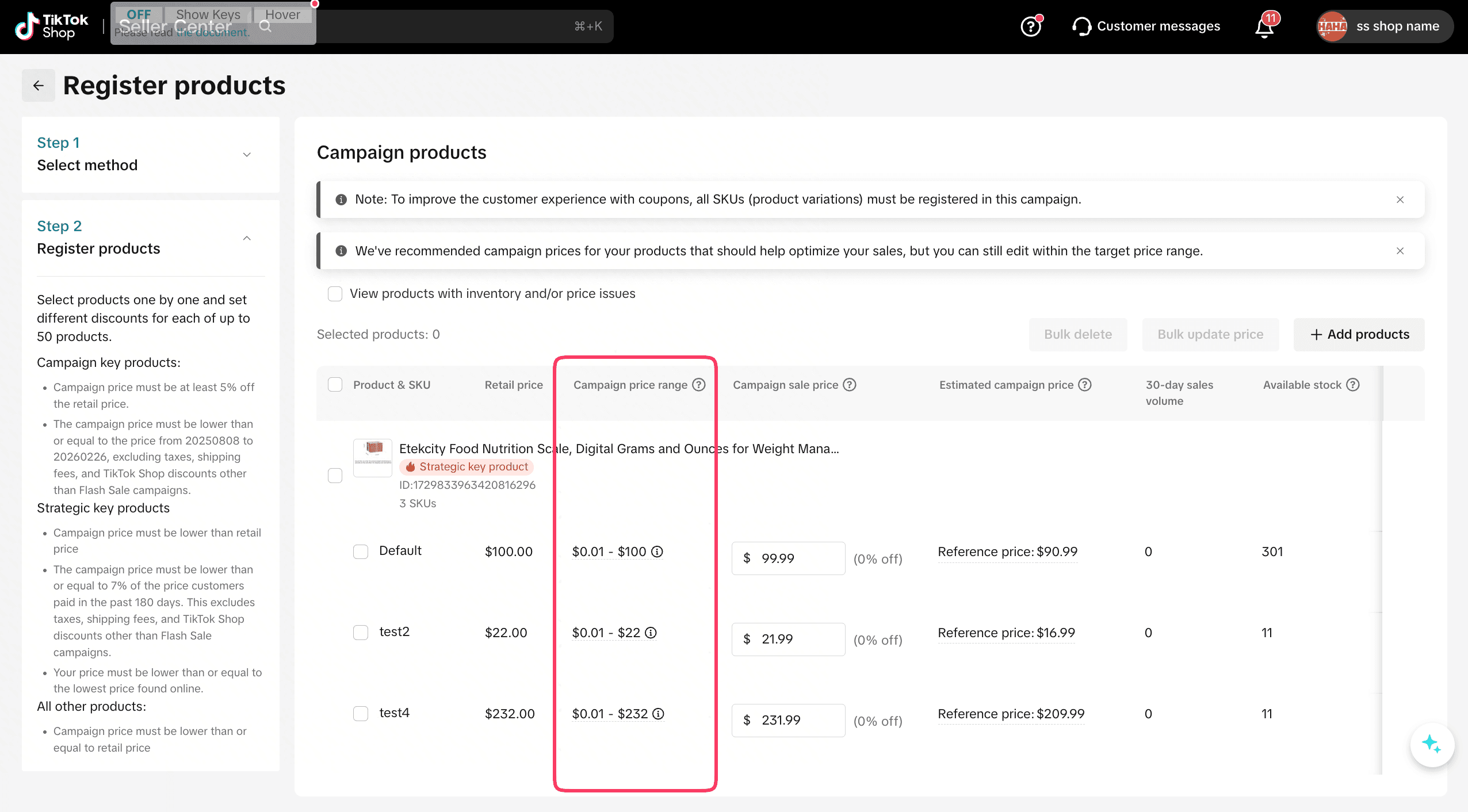
This range includes:
A minimum price
A maximum price (also called the threshold price)
Your campaign sale price must fall within both boundaries.
If you price above the maximum or below the minimum, the system will reject your registration.
This structure ensures campaigns offer competitive deals while protecting market fairness.
What Is the Campaign Price Threshold?
The campaign price threshold is the highest campaign price you are allowed to set.
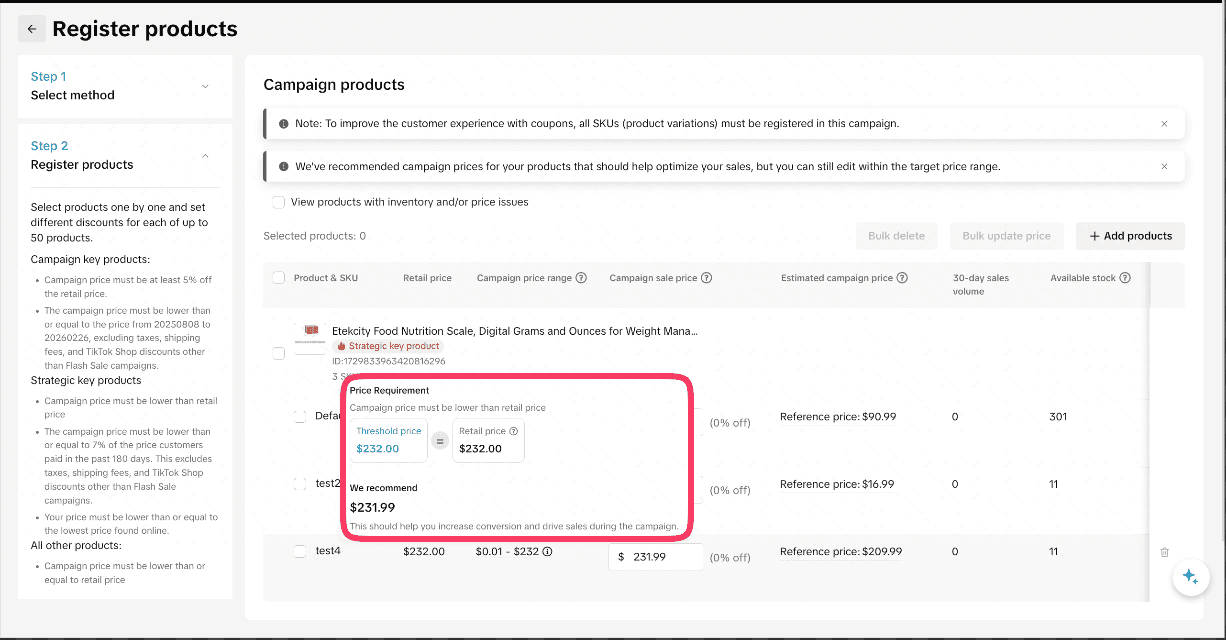
Think of it as the strictest acceptable ceiling based on all pricing rules applied to your product.
TikTok does not use just one rule. It can apply multiple rules simultaneously. Your price must satisfy all of them at the same time.
The platform automatically selects the most restrictive condition.
How the Threshold Is Calculated
Your product may be evaluated under several pricing checks.
Let’s break them down clearly.
1. Retail Price Rule
Campaigns may require a certain percentage discount from your retail price.
Example:
Retail price: $100
Required discount: 20 percent
Maximum campaign price: $80
If you try to set $85, the system will reject it.
2. Seller Discounted Price
If you are already running a seller promotion and your product is selling at $90, your campaign price may need to be lower than $90.
You cannot register at $95 if your current promotional price is $90.
3. Lowest Historical Price
TikTok may check the lowest price customers paid in the past 30, 60, or 90 days.
If the lowest historical sale was $75, your campaign price may need to be $75 or lower.
This is often the strictest rule.
Important strategic note:
Deep discounts today can limit your pricing flexibility tomorrow.
4. Supply Price
This includes all seller funded discounts combined, not just visible product discounts.
If your supply price calculation results in a lower effective number, that can influence the threshold.
5. Lowest Price Found Online
If similar products are listed at lower prices elsewhere, TikTok may adjust your threshold accordingly.
6. Other Campaign Prices
If your product is already registered in another campaign at a lower price, that price may become the new ceiling.
How Multiple Rules Work Together
If your product is evaluated under three rules:
≤ $80
< $90
≤ $75
The strictest rule applies.
Final threshold: ≤ $75.
You must set your campaign sale price at $75 or lower to qualify.
The system automatically calculates this intersection.
Common Pricing Mistakes Sellers Make
Looking only at retail discount requirements
Ignoring historical price impact
Forgetting active seller promotions
Not checking stacked coupon effects
Dropping price too aggressively before major campaigns
Pricing mistakes often happen because sellers do not check all active discount layers.
What Is the Estimated Campaign Price?
The Estimated Campaign Price shows the final price a shopper is likely to pay after all applicable promotions stack together.
This includes:
Your campaign sale price
Product level promotions
Cart level promotions
Coupons
The number customers see may be lower than your campaign sale price.
Why Estimated Price Matters More Than Campaign Price
Your campaign sale price is what you set.
The estimated campaign price is what the customer experiences.
If you set a campaign price of $12 but:
$1 product discount applies
$1 cart discount applies
$2 coupon applies
The final shopper price becomes $8.
Your effective discount becomes larger than planned.
This directly impacts profit margin.
Where You Can Monitor Pricing Transparency
TikTok provides visibility across several areas:
Campaign registration page
Campaign management tab
SKU level edit panel
Reference price breakdown view
Stacking rules section
Promotion simulator
Price forecast tool
Smart sellers review pricing from multiple angles before activating campaigns.
Understanding the Three Discount Layers
TikTok uses a layered structure to apply discounts.
Layer 1: Individual Product Promotions
Includes:
Campaign discounts
Product discounts
Flash sales
Within this layer, only the best discount applies.
If a product has both 30 percent and 50 percent off, the 50 percent wins.
Layer 2: Cart Level Promotions
Includes:
Buy More Save More
Gift with purchase
Spend thresholds
These apply in the shopping cart.
Layer 3: Coupons
Includes seller funded coupons.
These typically stack on top of the other two layers.
Promotions across different layers can combine.
This stacking is powerful for driving conversions but dangerous if not managed carefully.
How to Use the Promotion Simulator Strategically
The Promotion Simulator allows you to test combinations before launching.
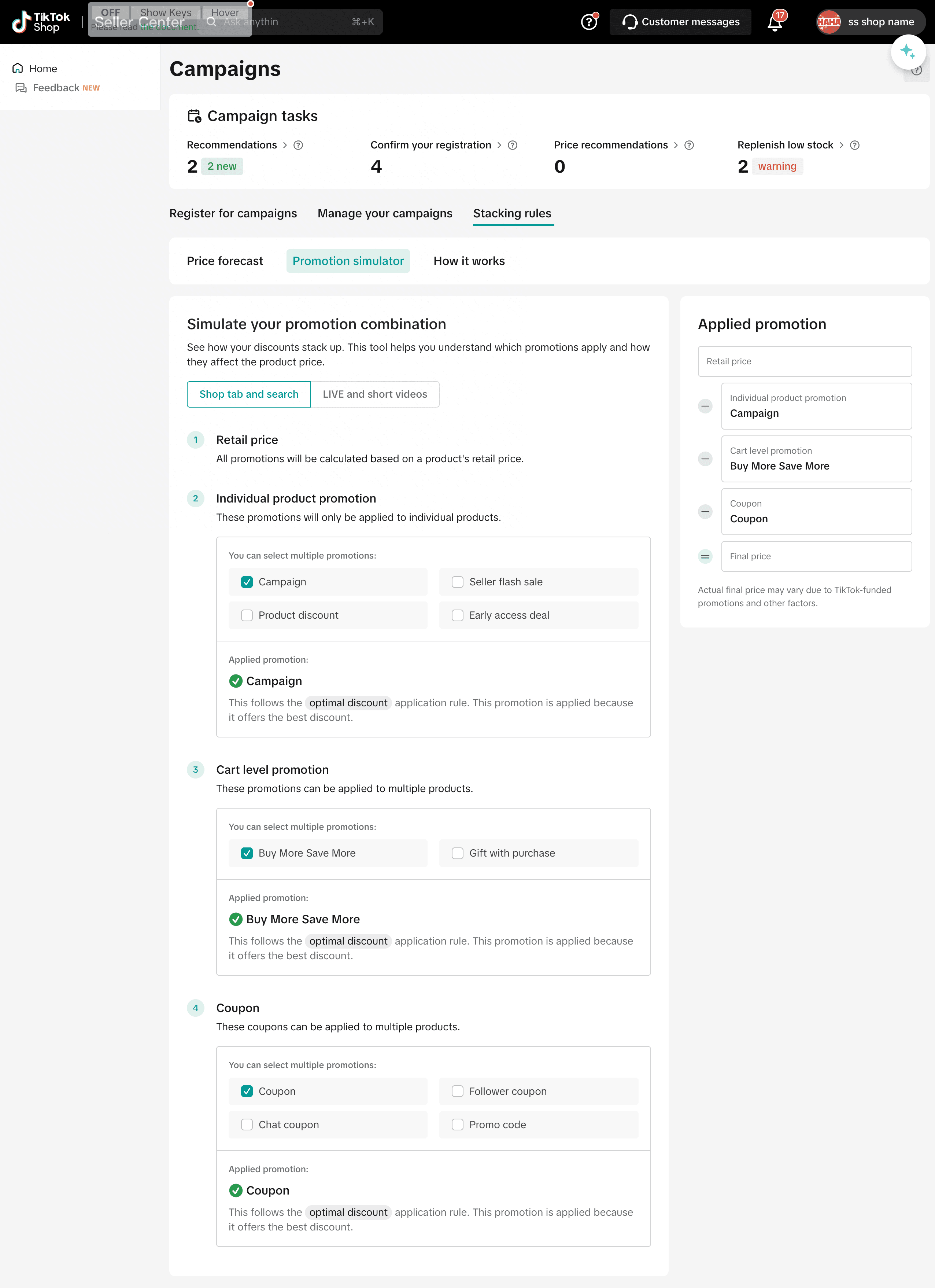
You can:
Select different promotion types
See which one wins within a layer
Understand stacking across layers
Preview final discount logic
This is extremely useful before running:
Flash sales
Creator campaigns
Live commerce events
Major shopping festivals
Think of it as a margin protection tool.
How to Use the Price Forecast Tool
The Price Forecast tool shows how your final shopper price will appear over time.
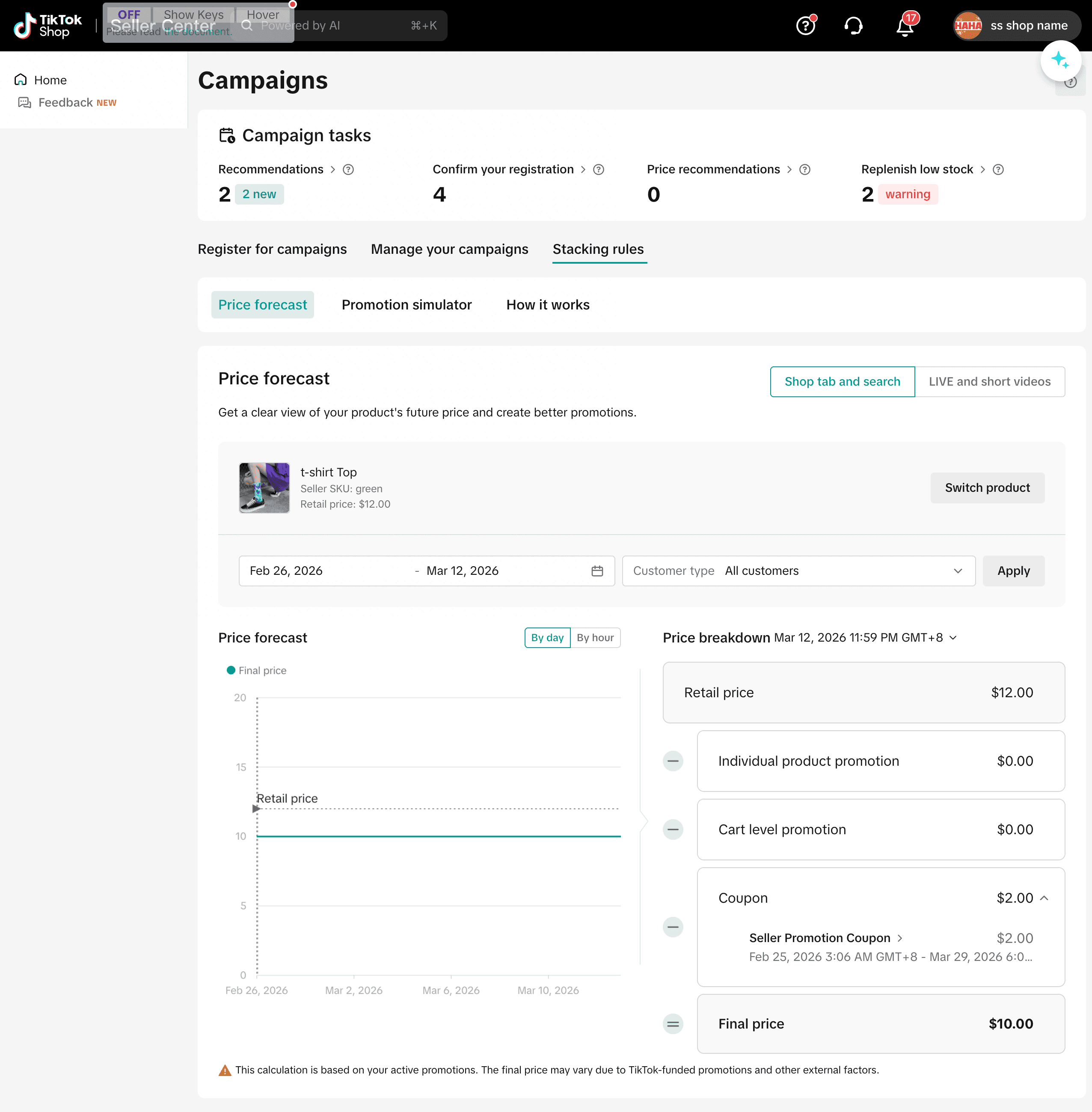
You can:
Select a product
Choose a date range
View timeline pricing
Hover to see breakdowns
Identify overlapping promotions
This helps you avoid unexpected pricing collisions.
For example, you may discover that:
A coupon launches the same day as your campaign
A flash sale overlaps with creator traffic
A cart discount doubles your intended promotion
Planning ahead prevents profit leakage.
Strategic Pricing for Creator-Led Commerce
On TikTok Shop, pricing works best when paired with strong content.
Creators amplify conversion when:
Discounts feel time sensitive
Offers are clearly framed
Bundles are positioned smartly
Value is demonstrated in storytelling
Deep discounts without content rarely maximize results.
This is why pricing and creator strategy must align.
Long-Term Pricing Discipline
Here is something many sellers overlook.
If you constantly discount heavily:
Your historical price lowers
Future campaign thresholds become stricter
Customers expect lower pricing
Brand value perception weakens
Short term volume should not destroy long term pricing flexibility.
Plan campaigns strategically rather than reactively.
How Zorilla Marketing Helps Brands Structure Pricing Smarter
At Zorilla Marketing, pricing is treated as part of a larger growth system.
We help brands:
Align pricing strategy with creator campaigns
Prevent excessive stacking
Structure promotional calendars
Coordinate live commerce pushes
Balance conversion with margin protection
Pricing is not just about eligibility. It is about profitable growth.
By combining pricing intelligence with influencer-led commerce, brands can scale revenue while maintaining control.
Final Thoughts
Campaign pricing on TikTok Shop is transparent, but only if you understand how to interpret it.
To succeed, you must:
Monitor price thresholds
Review historical price impact
Understand stacking layers
Use the simulator
Forecast future pricing
If you approach campaigns casually, you risk rejection or margin loss.
If you approach them strategically, pricing becomes a competitive advantage.
If you want help aligning your pricing, creators, and campaign calendar into a structured TikTok Shop growth plan, explore how Zorilla Marketing supports brands scaling profitably on the platform.
Book a free strategy call with our team today and let us help you make your Shop Tab presence your strongest sales channel.
Also read :
TikTok Shop Campaign Price Transparency: The Smart Seller’s Guide
TikTok Shop Campaign Pricing Explained for Growing Brands
If you sell on TikTok Shop, pricing is not just about choosing a discount. It is about understanding how the system evaluates your product, how multiple rules interact, and how different promotions stack together.
Many sellers lose margin not because they price incorrectly, but because they do not fully understand how campaign rules and layered discounts work.
This guide explains campaign price range, price thresholds, estimated campaign price, stacking logic, and how to use these tools strategically to grow sales without hurting profitability.
Why Campaign Pricing Deserves Serious Attention
On TikTok Shop, pricing affects more than just conversion rate. It impacts:
Campaign eligibility
Creator performance
Shopper trust
Margin health
Long term brand positioning
If your campaign price does not meet platform requirements, your product cannot join the campaign.
If your discounts stack too aggressively, your final shopper price may be lower than expected.
Growth without margin discipline is not sustainable.
Understanding the Campaign Price Range
When you register a product for a campaign, TikTok Shop shows a required price window.
This range includes:
A minimum price
A maximum price (also called the threshold price)
Your campaign sale price must fall within both boundaries.
If you price above the maximum or below the minimum, the system will reject your registration.
This structure ensures campaigns offer competitive deals while protecting market fairness.
What Is the Campaign Price Threshold?
The campaign price threshold is the highest campaign price you are allowed to set.
Think of it as the strictest acceptable ceiling based on all pricing rules applied to your product.
TikTok does not use just one rule. It can apply multiple rules simultaneously. Your price must satisfy all of them at the same time.
The platform automatically selects the most restrictive condition.
How the Threshold Is Calculated
Your product may be evaluated under several pricing checks.
Let’s break them down clearly.
1. Retail Price Rule
Campaigns may require a certain percentage discount from your retail price.
Example:
Retail price: $100
Required discount: 20 percent
Maximum campaign price: $80
If you try to set $85, the system will reject it.
2. Seller Discounted Price
If you are already running a seller promotion and your product is selling at $90, your campaign price may need to be lower than $90.
You cannot register at $95 if your current promotional price is $90.
3. Lowest Historical Price
TikTok may check the lowest price customers paid in the past 30, 60, or 90 days.
If the lowest historical sale was $75, your campaign price may need to be $75 or lower.
This is often the strictest rule.
Important strategic note:
Deep discounts today can limit your pricing flexibility tomorrow.
4. Supply Price
This includes all seller funded discounts combined, not just visible product discounts.
If your supply price calculation results in a lower effective number, that can influence the threshold.
5. Lowest Price Found Online
If similar products are listed at lower prices elsewhere, TikTok may adjust your threshold accordingly.
6. Other Campaign Prices
If your product is already registered in another campaign at a lower price, that price may become the new ceiling.
How Multiple Rules Work Together
If your product is evaluated under three rules:
≤ $80
< $90
≤ $75
The strictest rule applies.
Final threshold: ≤ $75.
You must set your campaign sale price at $75 or lower to qualify.
The system automatically calculates this intersection.
Common Pricing Mistakes Sellers Make
Looking only at retail discount requirements
Ignoring historical price impact
Forgetting active seller promotions
Not checking stacked coupon effects
Dropping price too aggressively before major campaigns
Pricing mistakes often happen because sellers do not check all active discount layers.
What Is the Estimated Campaign Price?
The Estimated Campaign Price shows the final price a shopper is likely to pay after all applicable promotions stack together.
This includes:
Your campaign sale price
Product level promotions
Cart level promotions
Coupons
The number customers see may be lower than your campaign sale price.
Why Estimated Price Matters More Than Campaign Price
Your campaign sale price is what you set.
The estimated campaign price is what the customer experiences.
If you set a campaign price of $12 but:
$1 product discount applies
$1 cart discount applies
$2 coupon applies
The final shopper price becomes $8.
Your effective discount becomes larger than planned.
This directly impacts profit margin.
Where You Can Monitor Pricing Transparency
TikTok provides visibility across several areas:
Campaign registration page
Campaign management tab
SKU level edit panel
Reference price breakdown view
Stacking rules section
Promotion simulator
Price forecast tool
Smart sellers review pricing from multiple angles before activating campaigns.
Understanding the Three Discount Layers
TikTok uses a layered structure to apply discounts.
Layer 1: Individual Product Promotions
Includes:
Campaign discounts
Product discounts
Flash sales
Within this layer, only the best discount applies.
If a product has both 30 percent and 50 percent off, the 50 percent wins.
Layer 2: Cart Level Promotions
Includes:
Buy More Save More
Gift with purchase
Spend thresholds
These apply in the shopping cart.
Layer 3: Coupons
Includes seller funded coupons.
These typically stack on top of the other two layers.
Promotions across different layers can combine.
This stacking is powerful for driving conversions but dangerous if not managed carefully.
How to Use the Promotion Simulator Strategically
The Promotion Simulator allows you to test combinations before launching.
You can:
Select different promotion types
See which one wins within a layer
Understand stacking across layers
Preview final discount logic
This is extremely useful before running:
Flash sales
Creator campaigns
Live commerce events
Major shopping festivals
Think of it as a margin protection tool.
How to Use the Price Forecast Tool
The Price Forecast tool shows how your final shopper price will appear over time.
You can:
Select a product
Choose a date range
View timeline pricing
Hover to see breakdowns
Identify overlapping promotions
This helps you avoid unexpected pricing collisions.
For example, you may discover that:
A coupon launches the same day as your campaign
A flash sale overlaps with creator traffic
A cart discount doubles your intended promotion
Planning ahead prevents profit leakage.
Strategic Pricing for Creator-Led Commerce
On TikTok Shop, pricing works best when paired with strong content.
Creators amplify conversion when:
Discounts feel time sensitive
Offers are clearly framed
Bundles are positioned smartly
Value is demonstrated in storytelling
Deep discounts without content rarely maximize results.
This is why pricing and creator strategy must align.
Long-Term Pricing Discipline
Here is something many sellers overlook.
If you constantly discount heavily:
Your historical price lowers
Future campaign thresholds become stricter
Customers expect lower pricing
Brand value perception weakens
Short term volume should not destroy long term pricing flexibility.
Plan campaigns strategically rather than reactively.
How Zorilla Marketing Helps Brands Structure Pricing Smarter
At Zorilla Marketing, pricing is treated as part of a larger growth system.
We help brands:
Align pricing strategy with creator campaigns
Prevent excessive stacking
Structure promotional calendars
Coordinate live commerce pushes
Balance conversion with margin protection
Pricing is not just about eligibility. It is about profitable growth.
By combining pricing intelligence with influencer-led commerce, brands can scale revenue while maintaining control.
Final Thoughts
Campaign pricing on TikTok Shop is transparent, but only if you understand how to interpret it.
To succeed, you must:
Monitor price thresholds
Review historical price impact
Understand stacking layers
Use the simulator
Forecast future pricing
If you approach campaigns casually, you risk rejection or margin loss.
If you approach them strategically, pricing becomes a competitive advantage.
If you want help aligning your pricing, creators, and campaign calendar into a structured TikTok Shop growth plan, explore how Zorilla Marketing supports brands scaling profitably on the platform.
Book a free strategy call with our team today and let us help you make your Shop Tab presence your strongest sales channel.
Also read :


A complete seller guide to mastering TikTok Shop campaign pricing, thresholds, stacking rules, and margin protection.
TikTok Shop Campaign Price Transparency: The Smart Seller’s Guide
TikTok Shop Campaign Pricing Explained for Growing Brands
If you sell on TikTok Shop, pricing is not just about choosing a discount. It is about understanding how the system evaluates your product, how multiple rules interact, and how different promotions stack together.
Many sellers lose margin not because they price incorrectly, but because they do not fully understand how campaign rules and layered discounts work.
This guide explains campaign price range, price thresholds, estimated campaign price, stacking logic, and how to use these tools strategically to grow sales without hurting profitability.
Why Campaign Pricing Deserves Serious Attention
On TikTok Shop, pricing affects more than just conversion rate. It impacts:
Campaign eligibility
Creator performance
Shopper trust
Margin health
Long term brand positioning
If your campaign price does not meet platform requirements, your product cannot join the campaign.
If your discounts stack too aggressively, your final shopper price may be lower than expected.
Growth without margin discipline is not sustainable.
Understanding the Campaign Price Range
When you register a product for a campaign, TikTok Shop shows a required price window.
This range includes:
A minimum price
A maximum price (also called the threshold price)
Your campaign sale price must fall within both boundaries.
If you price above the maximum or below the minimum, the system will reject your registration.
This structure ensures campaigns offer competitive deals while protecting market fairness.
What Is the Campaign Price Threshold?
The campaign price threshold is the highest campaign price you are allowed to set.
Think of it as the strictest acceptable ceiling based on all pricing rules applied to your product.
TikTok does not use just one rule. It can apply multiple rules simultaneously. Your price must satisfy all of them at the same time.
The platform automatically selects the most restrictive condition.
How the Threshold Is Calculated
Your product may be evaluated under several pricing checks.
Let’s break them down clearly.
1. Retail Price Rule
Campaigns may require a certain percentage discount from your retail price.
Example:
Retail price: $100
Required discount: 20 percent
Maximum campaign price: $80
If you try to set $85, the system will reject it.
2. Seller Discounted Price
If you are already running a seller promotion and your product is selling at $90, your campaign price may need to be lower than $90.
You cannot register at $95 if your current promotional price is $90.
3. Lowest Historical Price
TikTok may check the lowest price customers paid in the past 30, 60, or 90 days.
If the lowest historical sale was $75, your campaign price may need to be $75 or lower.
This is often the strictest rule.
Important strategic note:
Deep discounts today can limit your pricing flexibility tomorrow.
4. Supply Price
This includes all seller funded discounts combined, not just visible product discounts.
If your supply price calculation results in a lower effective number, that can influence the threshold.
5. Lowest Price Found Online
If similar products are listed at lower prices elsewhere, TikTok may adjust your threshold accordingly.
6. Other Campaign Prices
If your product is already registered in another campaign at a lower price, that price may become the new ceiling.
How Multiple Rules Work Together
If your product is evaluated under three rules:
≤ $80
< $90
≤ $75
The strictest rule applies.
Final threshold: ≤ $75.
You must set your campaign sale price at $75 or lower to qualify.
The system automatically calculates this intersection.
Common Pricing Mistakes Sellers Make
Looking only at retail discount requirements
Ignoring historical price impact
Forgetting active seller promotions
Not checking stacked coupon effects
Dropping price too aggressively before major campaigns
Pricing mistakes often happen because sellers do not check all active discount layers.
What Is the Estimated Campaign Price?
The Estimated Campaign Price shows the final price a shopper is likely to pay after all applicable promotions stack together.
This includes:
Your campaign sale price
Product level promotions
Cart level promotions
Coupons
The number customers see may be lower than your campaign sale price.
Why Estimated Price Matters More Than Campaign Price
Your campaign sale price is what you set.
The estimated campaign price is what the customer experiences.
If you set a campaign price of $12 but:
$1 product discount applies
$1 cart discount applies
$2 coupon applies
The final shopper price becomes $8.
Your effective discount becomes larger than planned.
This directly impacts profit margin.
Where You Can Monitor Pricing Transparency
TikTok provides visibility across several areas:
Campaign registration page
Campaign management tab
SKU level edit panel
Reference price breakdown view
Stacking rules section
Promotion simulator
Price forecast tool
Smart sellers review pricing from multiple angles before activating campaigns.
Understanding the Three Discount Layers
TikTok uses a layered structure to apply discounts.
Layer 1: Individual Product Promotions
Includes:
Campaign discounts
Product discounts
Flash sales
Within this layer, only the best discount applies.
If a product has both 30 percent and 50 percent off, the 50 percent wins.
Layer 2: Cart Level Promotions
Includes:
Buy More Save More
Gift with purchase
Spend thresholds
These apply in the shopping cart.
Layer 3: Coupons
Includes seller funded coupons.
These typically stack on top of the other two layers.
Promotions across different layers can combine.
This stacking is powerful for driving conversions but dangerous if not managed carefully.
How to Use the Promotion Simulator Strategically
The Promotion Simulator allows you to test combinations before launching.
You can:
Select different promotion types
See which one wins within a layer
Understand stacking across layers
Preview final discount logic
This is extremely useful before running:
Flash sales
Creator campaigns
Live commerce events
Major shopping festivals
Think of it as a margin protection tool.
How to Use the Price Forecast Tool
The Price Forecast tool shows how your final shopper price will appear over time.
You can:
Select a product
Choose a date range
View timeline pricing
Hover to see breakdowns
Identify overlapping promotions
This helps you avoid unexpected pricing collisions.
For example, you may discover that:
A coupon launches the same day as your campaign
A flash sale overlaps with creator traffic
A cart discount doubles your intended promotion
Planning ahead prevents profit leakage.
Strategic Pricing for Creator-Led Commerce
On TikTok Shop, pricing works best when paired with strong content.
Creators amplify conversion when:
Discounts feel time sensitive
Offers are clearly framed
Bundles are positioned smartly
Value is demonstrated in storytelling
Deep discounts without content rarely maximize results.
This is why pricing and creator strategy must align.
Long-Term Pricing Discipline
Here is something many sellers overlook.
If you constantly discount heavily:
Your historical price lowers
Future campaign thresholds become stricter
Customers expect lower pricing
Brand value perception weakens
Short term volume should not destroy long term pricing flexibility.
Plan campaigns strategically rather than reactively.
How Zorilla Marketing Helps Brands Structure Pricing Smarter
At Zorilla Marketing, pricing is treated as part of a larger growth system.
We help brands:
Align pricing strategy with creator campaigns
Prevent excessive stacking
Structure promotional calendars
Coordinate live commerce pushes
Balance conversion with margin protection
Pricing is not just about eligibility. It is about profitable growth.
By combining pricing intelligence with influencer-led commerce, brands can scale revenue while maintaining control.
Final Thoughts
Campaign pricing on TikTok Shop is transparent, but only if you understand how to interpret it.
To succeed, you must:
Monitor price thresholds
Review historical price impact
Understand stacking layers
Use the simulator
Forecast future pricing
If you approach campaigns casually, you risk rejection or margin loss.
If you approach them strategically, pricing becomes a competitive advantage.
If you want help aligning your pricing, creators, and campaign calendar into a structured TikTok Shop growth plan, explore how Zorilla Marketing supports brands scaling profitably on the platform.
Book a free strategy call with our team today and let us help you make your Shop Tab presence your strongest sales channel.
Also read :
Other Blogs
Other Blogs
Check our other project Blogs with useful insight and information for your businesses



Other Blogs
Other Blogs
Check our other project Blogs with useful insight and information for your businesses