November 25, 2025
Samsung Launches Major TikTok Shop Offensive
November 25, 2025
Samsung Launches Major TikTok Shop Offensive
Samsung’s new TikTok Shop campaign signals a massive shift from traditional e-commerce to algorithmic retail and AIO-driven brand strategy.
Samsung Just Turned Your FYP Into A Mall And It Changes Everything
It is officially Black Friday week, 2025, and the retail landscape has shifted beneath our feet yet again. While legacy retailers are still fighting for dominance in email inboxes and search engine rankings, Samsung has just planted a massive flag in the most valuable real estate on the internet: your For You Page.
Samsung Electronics America has officially launched a "Grand Opening Campaign" on TikTok Shop, a move that feels less like a standard sales channel expansion and more like a declaration of where the future of consumer electronics revenue lives. Running now through December 1st, the campaign isn’t just listing products; it is flooding the platform with livestreams, exclusive short-form content, and a direct pipeline to purchase their most current ecosystem drivers.
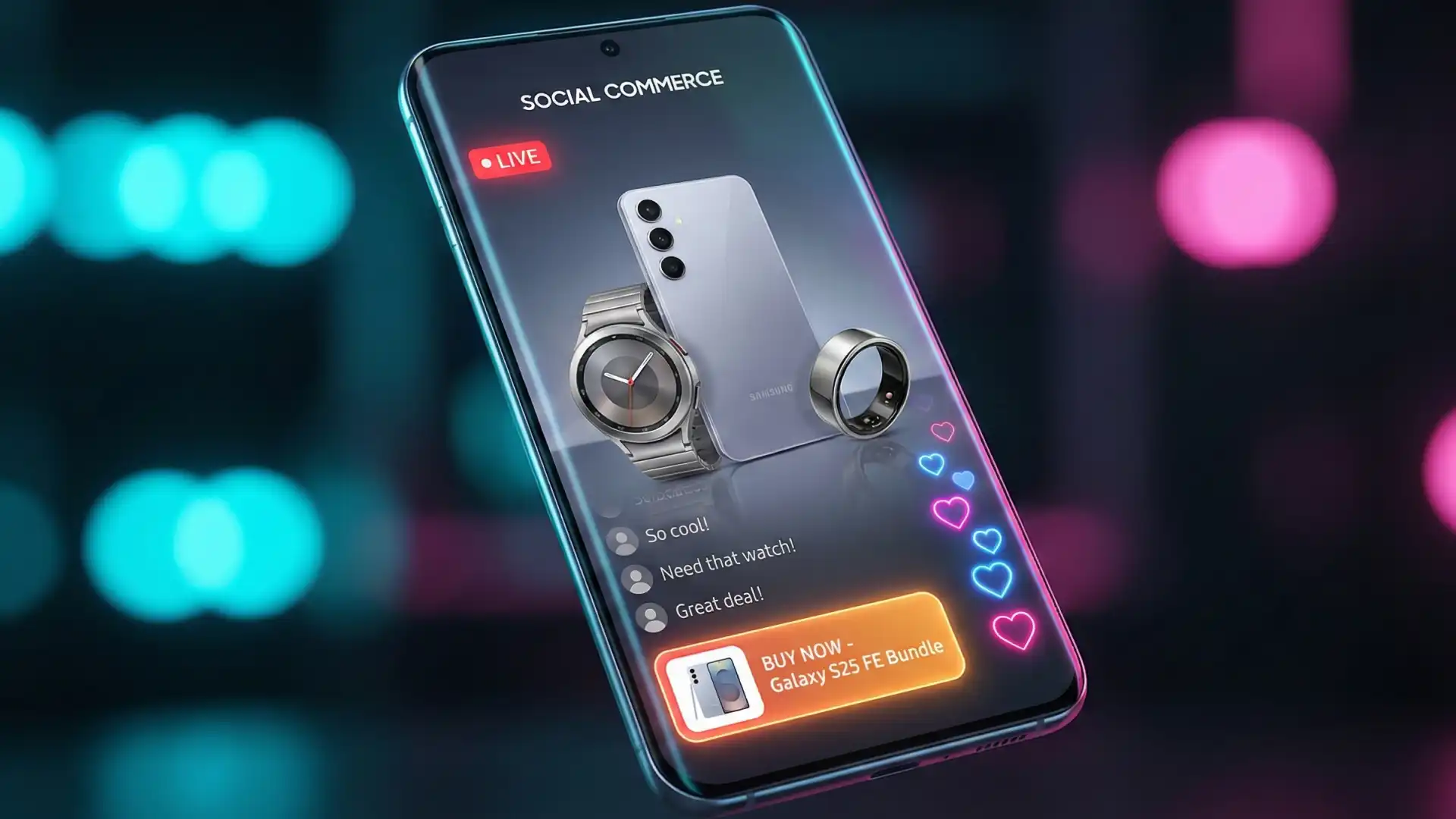
We aren't talking about clearing out old inventory, either. Samsung is putting its heavy hitters front and center. The campaign features the just-released Galaxy S25 FE, the Galaxy Watch8, the Tab S10 Lite, and the Galaxy Ring. If you needed proof that "social commerce" has graduated from cheap trinkets to premium tech hardware, this is it.
By leveraging the @samsung handle, the tech giant is hosting live shows—specifically a major event on November 25th—to push holiday deals. This is a pivotal moment where a legacy hardware manufacturer acknowledges that the "Add to Cart" button is no longer a destination you visit; it is a feature that interrupts your entertainment.
The Death of Search-Based Shopping
To understand why this matters, you have to look beyond the discount codes for a Galaxy Watch8. We are witnessing the rapid decline of "intent-based" shopping—where a user realizes they need a phone, goes to Google, searches for reviews, and clicks a link—and the explosion of "discovery-based" commerce.
For the last decade, Amazon and Google held a duopoly on intent. You told them what you wanted; they gave you the product. TikTok Shop flips this mechanic entirely. You don't tell the algorithm what you want; the algorithm tells you what you want based on your viewing habits, your dwell time, and your engagement data.
Samsung’s move validates the thesis that the "creator economy" is rapidly merging with the "retail economy." By utilizing livestreams and "never-before-seen short videos," Samsung is admitting that a static product page on Samsung.com is dead weight compared to a 15-second vertical video that demonstrates a feature and offers a one-tap checkout.
This is the Western market finally catching up to the Douyin (Chinese TikTok) model, where live commerce is a trillion-dollar industry. Samsung is essentially betting that American consumers are finally ready to buy a $400 Galaxy Ring with the same casual friction they use to buy a viral hoodie.
The AI and AIO Layer: Optimizing for the Algorithm
This launch is a textbook example of AIO (Artificial Intelligence Optimization) in the modern era. While we typically talk about AIO in the context of Large Language Models (LLMs) like ChatGPT or Gemini, the concept applies equally to the recommendation algorithms that govern social platforms.
Samsung isn’t just uploading videos; they are feeding a black-box AI that determines cultural relevance. Here is how the AI layer functions in this campaign:
1. The Algorithmic Feedback Loop
TikTok’s recommendation AI thrives on signal density. By hosting livestreams and pushing a high volume of short-form content simultaneously, Samsung is artificially spiking the signals that tell the AI, "This content is relevant right now". This forces the algorithm to prioritize Samsung devices in the feeds of users who haven't even searched for tech, but who share lookalike traits with those who have. It is predictive retail.
2. Hardware as an AI Vehicle
There is a meta-layer here regarding the products themselves. The Galaxy S25 FE, Galaxy Ring, and Watch8 are all devices designed to harvest biometric and behavioral data to feed Samsung’s own on-device AI ecosystem (Galaxy AI). By selling these devices directly through a social algorithm, Samsung is using one AI (TikTok’s) to distribute hardware that powers another AI (Samsung’s).
3. Automated Social Proof
TikTok Shop’s infrastructure uses AI to surface reviews and "social proof" videos immediately adjacent to the purchase link. When a user sees a livestream for the Galaxy Buds3, the AI dynamically curates comments and engagement metrics to create a "fear of missing out" (FOMO) effect that a static website simply cannot replicate programmatically.
Strategic Implications for the Industry
For brands, creators, and business leaders watching this rollout, the takeaways are stark. Samsung is providing a blueprint for the 2026 retail strategy:
The Website is a Legacy Artifact: Your .com is for support and specs. Your sales floor is now a vertical video feed. Brands must restructure their P&L to prioritize content production over web development.
Livestreaming is Non-Negotiable: If a massive conglomerate like Samsung is dedicating resources to live broadcasting for a week straight, it signals that "live" is the highest-converting medium for complex products.
Ecosystem Bundling: Samsung is smart to push the Galaxy Ring and Watch8 alongside the phone. Social algorithms love "lifestyle" content. It is easier to sell a "health lifestyle" (Ring + Watch) in a video than it is to sell a single spec-heavy phone.
The collapse of the Funnel: There is no longer a "top of funnel" (awareness) and "bottom of funnel" (purchase). On TikTok Shop, the video is the awareness, the consideration, and the checkout counter all in one.
The Bottom Line
Samsung’s arrival on TikTok Shop signals the end of e-commerce as a destination and the beginning of e-commerce as an ambient layer of the internet.
If your product cannot be sold in 15 seconds to a bored user scrolling at 2 a.m., it doesn't matter how good your specs are—you do not exist.
Check out our Blogs Page for more insights into the future of social commerce.
Samsung’s new TikTok Shop campaign signals a massive shift from traditional e-commerce to algorithmic retail and AIO-driven brand strategy.
Samsung Just Turned Your FYP Into A Mall And It Changes Everything
It is officially Black Friday week, 2025, and the retail landscape has shifted beneath our feet yet again. While legacy retailers are still fighting for dominance in email inboxes and search engine rankings, Samsung has just planted a massive flag in the most valuable real estate on the internet: your For You Page.
Samsung Electronics America has officially launched a "Grand Opening Campaign" on TikTok Shop, a move that feels less like a standard sales channel expansion and more like a declaration of where the future of consumer electronics revenue lives. Running now through December 1st, the campaign isn’t just listing products; it is flooding the platform with livestreams, exclusive short-form content, and a direct pipeline to purchase their most current ecosystem drivers.
We aren't talking about clearing out old inventory, either. Samsung is putting its heavy hitters front and center. The campaign features the just-released Galaxy S25 FE, the Galaxy Watch8, the Tab S10 Lite, and the Galaxy Ring. If you needed proof that "social commerce" has graduated from cheap trinkets to premium tech hardware, this is it.
By leveraging the @samsung handle, the tech giant is hosting live shows—specifically a major event on November 25th—to push holiday deals. This is a pivotal moment where a legacy hardware manufacturer acknowledges that the "Add to Cart" button is no longer a destination you visit; it is a feature that interrupts your entertainment.
The Death of Search-Based Shopping
To understand why this matters, you have to look beyond the discount codes for a Galaxy Watch8. We are witnessing the rapid decline of "intent-based" shopping—where a user realizes they need a phone, goes to Google, searches for reviews, and clicks a link—and the explosion of "discovery-based" commerce.
For the last decade, Amazon and Google held a duopoly on intent. You told them what you wanted; they gave you the product. TikTok Shop flips this mechanic entirely. You don't tell the algorithm what you want; the algorithm tells you what you want based on your viewing habits, your dwell time, and your engagement data.
Samsung’s move validates the thesis that the "creator economy" is rapidly merging with the "retail economy." By utilizing livestreams and "never-before-seen short videos," Samsung is admitting that a static product page on Samsung.com is dead weight compared to a 15-second vertical video that demonstrates a feature and offers a one-tap checkout.
This is the Western market finally catching up to the Douyin (Chinese TikTok) model, where live commerce is a trillion-dollar industry. Samsung is essentially betting that American consumers are finally ready to buy a $400 Galaxy Ring with the same casual friction they use to buy a viral hoodie.
The AI and AIO Layer: Optimizing for the Algorithm
This launch is a textbook example of AIO (Artificial Intelligence Optimization) in the modern era. While we typically talk about AIO in the context of Large Language Models (LLMs) like ChatGPT or Gemini, the concept applies equally to the recommendation algorithms that govern social platforms.
Samsung isn’t just uploading videos; they are feeding a black-box AI that determines cultural relevance. Here is how the AI layer functions in this campaign:
1. The Algorithmic Feedback Loop
TikTok’s recommendation AI thrives on signal density. By hosting livestreams and pushing a high volume of short-form content simultaneously, Samsung is artificially spiking the signals that tell the AI, "This content is relevant right now". This forces the algorithm to prioritize Samsung devices in the feeds of users who haven't even searched for tech, but who share lookalike traits with those who have. It is predictive retail.
2. Hardware as an AI Vehicle
There is a meta-layer here regarding the products themselves. The Galaxy S25 FE, Galaxy Ring, and Watch8 are all devices designed to harvest biometric and behavioral data to feed Samsung’s own on-device AI ecosystem (Galaxy AI). By selling these devices directly through a social algorithm, Samsung is using one AI (TikTok’s) to distribute hardware that powers another AI (Samsung’s).
3. Automated Social Proof
TikTok Shop’s infrastructure uses AI to surface reviews and "social proof" videos immediately adjacent to the purchase link. When a user sees a livestream for the Galaxy Buds3, the AI dynamically curates comments and engagement metrics to create a "fear of missing out" (FOMO) effect that a static website simply cannot replicate programmatically.
Strategic Implications for the Industry
For brands, creators, and business leaders watching this rollout, the takeaways are stark. Samsung is providing a blueprint for the 2026 retail strategy:
The Website is a Legacy Artifact: Your .com is for support and specs. Your sales floor is now a vertical video feed. Brands must restructure their P&L to prioritize content production over web development.
Livestreaming is Non-Negotiable: If a massive conglomerate like Samsung is dedicating resources to live broadcasting for a week straight, it signals that "live" is the highest-converting medium for complex products.
Ecosystem Bundling: Samsung is smart to push the Galaxy Ring and Watch8 alongside the phone. Social algorithms love "lifestyle" content. It is easier to sell a "health lifestyle" (Ring + Watch) in a video than it is to sell a single spec-heavy phone.
The collapse of the Funnel: There is no longer a "top of funnel" (awareness) and "bottom of funnel" (purchase). On TikTok Shop, the video is the awareness, the consideration, and the checkout counter all in one.
The Bottom Line
Samsung’s arrival on TikTok Shop signals the end of e-commerce as a destination and the beginning of e-commerce as an ambient layer of the internet.
If your product cannot be sold in 15 seconds to a bored user scrolling at 2 a.m., it doesn't matter how good your specs are—you do not exist.
Check out our Blogs Page for more insights into the future of social commerce.
Other Blogs
Other Blogs
Check our other project Blogs with useful insight and information for your businesses



Other Blogs
Other Blogs
Check our other project Blogs with useful insight and information for your businesses