March 24, 2026
TikTok, iHeart redefine artist launch strategy
March 24, 2026
TikTok, iHeart redefine artist launch strategy
TikTok and iHeartMedia test a new artist launch model blending radio, AI, and social momentum at scale.
TikTok and iHeart Just Rewrote the Modern Artist Launch Playbook
he music industry has spent the last decade trying to answer a deceptively simple question: how do you launch a hit in the age of algorithms?
Now, two of the most influential distribution engines TikTok and iHeartMedia think they’ve cracked it.
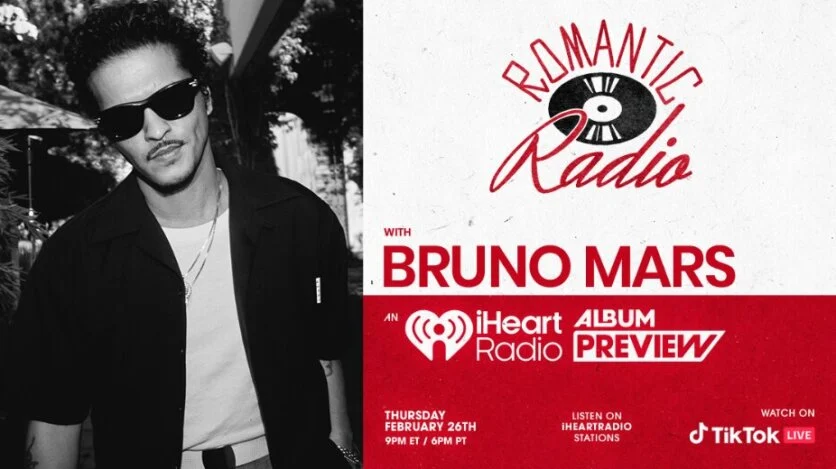
Their experiment? A coordinated rollout around Bruno Mars’ track “The Romantic,” designed not as a traditional release, but as a multi-platform ignition moment. Instead of relying on either radio airplay or social virality alone, the campaign fused both tightly, intentionally, and in real time.
The result wasn’t just a promotional push. It was positioned as a “blueprint” a repeatable system for launching music in a fragmented, algorithm-driven attention economy.
And if that sounds like marketing spin, it’s not. It’s something more structural: a signal that the industry is moving toward orchestrated visibility rather than hoping for organic discovery.
Deeper Insight / Trend Connection
For years, the music business has been split between two dominant forces: legacy distribution (radio, labels, curated playlists) and chaotic discovery (TikTok trends, creator remixes, viral loops).
What this campaign suggests is that the future isn’t choosing one over the other it’s synchronization.
TikTok brings speed, cultural relevance, and unpredictable virality. iHeartMedia brings scale, audience trust, and distribution discipline. Together, they create something closer to a feedback loop than a funnel.
This is the real shift: music launches are becoming systems, not moments.
Instead of:
Drop a song
Hope it trends
Then push to radio
We’re seeing:
Seed cultural signals on TikTok
Amplify instantly through radio
Feed engagement data back into the system
Iterate distribution in near real time
This is closer to how tech products launch than how songs used to. It’s iterative, data-informed, and cross-channel by design.
In other words, the music industry is quietly adopting product growth mechanics.
AI + AIO Layer
Zoom out, and this “blueprint” starts to look less like a marketing strategy and more like an early version of AIO Artificial Intelligence Orchestration.
Because what TikTok and iHeartMedia are really doing is coordinating attention flows across platforms.
TikTok’s algorithm already acts as a massive AI discovery engine, predicting which sounds, hooks, and clips will resonate. Meanwhile, radio networks like iHeartMedia operate on audience analytics, demographic segmentation, and predictive programming.
When you combine them, you get a system that can:
Detect early engagement signals (TikTok)
Validate them at scale (radio)
Reinforce them through repetition
Optimize timing and reach dynamically
That’s not just distribution it’s orchestration.
In the near future, this process becomes even more automated:
AI identifies which song snippets are most “loopable”
It predicts which creator segments will amplify them
It times radio pushes based on engagement spikes
It adapts campaign strategy in real time
This is where AIO enters: not just using AI tools, but coordinating multiple intelligent systems to produce a unified outcome attention at scale.
The Bruno Mars campaign is a human-led version of what will soon be largely machine-assisted.
Strategic or Industry Implications
For labels, creators, and brands, this shift is more than interesting it’s actionable.
Here’s what stands out:
1. Launches are no longer linear
The old release cycle is dead. Success now depends on simultaneous multi-channel activation, not staged rollouts.
2. TikTok is no longer just discovery it’s infrastructure
It’s becoming a core layer of the music distribution stack, not just a marketing add-on.
3. Radio isn’t obsolete it’s evolving
Rather than competing with social platforms, radio is being repositioned as an amplifier for digital signals.
4. Data feedback loops are the new A&R
Early engagement metrics are shaping decisions faster than traditional gatekeepers ever could.
5. Creators are implicit collaborators
Even when not formally involved, TikTok creators act as distributed marketers, remixers, and cultural translators.
6. Timing is becoming algorithmic
When a song hits radio or gets pushed harder is increasingly based on data patterns, not calendar planning.
7. AI orchestration will define winners
The advantage won’t go to whoever has the biggest budget but to whoever best coordinates platforms, data, and timing.
The Bottom Line
What TikTok and iHeartMedia are building isn’t just a better way to launch songs it’s a prototype for how culture itself will be engineered.
In a world where attention is fragmented and algorithms decide what surfaces, success belongs to those who can orchestrate visibility, not just create content.
The next generation of hits won’t just go viral. They’ll be systemically amplified designed to move seamlessly between platforms, powered by data, and increasingly guided by AI.
The playbook is no longer “make something great and hope it spreads.”
Read also :

TikTok and iHeartMedia test a new artist launch model blending radio, AI, and social momentum at scale.
TikTok and iHeart Just Rewrote the Modern Artist Launch Playbook
he music industry has spent the last decade trying to answer a deceptively simple question: how do you launch a hit in the age of algorithms?
Now, two of the most influential distribution engines TikTok and iHeartMedia think they’ve cracked it.
Their experiment? A coordinated rollout around Bruno Mars’ track “The Romantic,” designed not as a traditional release, but as a multi-platform ignition moment. Instead of relying on either radio airplay or social virality alone, the campaign fused both tightly, intentionally, and in real time.
The result wasn’t just a promotional push. It was positioned as a “blueprint” a repeatable system for launching music in a fragmented, algorithm-driven attention economy.
And if that sounds like marketing spin, it’s not. It’s something more structural: a signal that the industry is moving toward orchestrated visibility rather than hoping for organic discovery.
Deeper Insight / Trend Connection
For years, the music business has been split between two dominant forces: legacy distribution (radio, labels, curated playlists) and chaotic discovery (TikTok trends, creator remixes, viral loops).
What this campaign suggests is that the future isn’t choosing one over the other it’s synchronization.
TikTok brings speed, cultural relevance, and unpredictable virality. iHeartMedia brings scale, audience trust, and distribution discipline. Together, they create something closer to a feedback loop than a funnel.
This is the real shift: music launches are becoming systems, not moments.
Instead of:
Drop a song
Hope it trends
Then push to radio
We’re seeing:
Seed cultural signals on TikTok
Amplify instantly through radio
Feed engagement data back into the system
Iterate distribution in near real time
This is closer to how tech products launch than how songs used to. It’s iterative, data-informed, and cross-channel by design.
In other words, the music industry is quietly adopting product growth mechanics.
AI + AIO Layer
Zoom out, and this “blueprint” starts to look less like a marketing strategy and more like an early version of AIO Artificial Intelligence Orchestration.
Because what TikTok and iHeartMedia are really doing is coordinating attention flows across platforms.
TikTok’s algorithm already acts as a massive AI discovery engine, predicting which sounds, hooks, and clips will resonate. Meanwhile, radio networks like iHeartMedia operate on audience analytics, demographic segmentation, and predictive programming.
When you combine them, you get a system that can:
Detect early engagement signals (TikTok)
Validate them at scale (radio)
Reinforce them through repetition
Optimize timing and reach dynamically
That’s not just distribution it’s orchestration.
In the near future, this process becomes even more automated:
AI identifies which song snippets are most “loopable”
It predicts which creator segments will amplify them
It times radio pushes based on engagement spikes
It adapts campaign strategy in real time
This is where AIO enters: not just using AI tools, but coordinating multiple intelligent systems to produce a unified outcome attention at scale.
The Bruno Mars campaign is a human-led version of what will soon be largely machine-assisted.
Strategic or Industry Implications
For labels, creators, and brands, this shift is more than interesting it’s actionable.
Here’s what stands out:
1. Launches are no longer linear
The old release cycle is dead. Success now depends on simultaneous multi-channel activation, not staged rollouts.
2. TikTok is no longer just discovery it’s infrastructure
It’s becoming a core layer of the music distribution stack, not just a marketing add-on.
3. Radio isn’t obsolete it’s evolving
Rather than competing with social platforms, radio is being repositioned as an amplifier for digital signals.
4. Data feedback loops are the new A&R
Early engagement metrics are shaping decisions faster than traditional gatekeepers ever could.
5. Creators are implicit collaborators
Even when not formally involved, TikTok creators act as distributed marketers, remixers, and cultural translators.
6. Timing is becoming algorithmic
When a song hits radio or gets pushed harder is increasingly based on data patterns, not calendar planning.
7. AI orchestration will define winners
The advantage won’t go to whoever has the biggest budget but to whoever best coordinates platforms, data, and timing.
The Bottom Line
What TikTok and iHeartMedia are building isn’t just a better way to launch songs it’s a prototype for how culture itself will be engineered.
In a world where attention is fragmented and algorithms decide what surfaces, success belongs to those who can orchestrate visibility, not just create content.
The next generation of hits won’t just go viral. They’ll be systemically amplified designed to move seamlessly between platforms, powered by data, and increasingly guided by AI.
The playbook is no longer “make something great and hope it spreads.”
Read also :
Other Blogs
Other Blogs
Check our other project Blogs with useful insight and information for your businesses


Other Blogs
Other Blogs
Check our other project Blogs with useful insight and information for your businesses